Tampilkan postingan dengan label Haida. Tampilkan semua postingan

Senin, 27 Februari 2012

Tuesday Poem: Superior Corvid


One metre long from beak to tail-tip
more black than black and curious,
quick to mimic, clever, a problem-
solver, shape-shifter, solitary
but coupling for life. (They often
live for forty years.) Gate-keeper,
talisman, prognosticator, doom-
merchant. At a distance sometimes
mistaken for the common crow.

Kathleen Jones


This is one small raven poem from my growing 'Haida Gwaii' collection which is going to be called 'Sea, Tree and Bird' and which seems to be becoming more of a meditation on how we live with the environment, though it didn't start out that way.

The beautiful Raven photo was taken by Gavan Watson and is licensed under the Creative Commons agreement.

Selasa, 13 Desember 2011

Tuesday Poem: One Raven

That day by the lake
when you wouldn’t stop and
I made you and you stalked
off into the bracken and I sat
on the rock looking up
at the crag  wondering why
do I always take it why
am I still here and then
saw a bird circling
as a crow circles its carrion -
but more slowly, wings spread wide
and the feathers fanned out against the sun
and it seemed larger and darker
with more history than a common scavenger
and then I knew I was watching an omen,
riding the thermal, effortless,
croaking a harsh truth.

Kathleen Jones


I've now got almost a complete collection of poems on the raven theme, inspired by the culture of the Haida Gwaii indians of North America.   This one is about a quarrel (quite a long time ago now) and the moment of realisation when you know a relationship is going nowhere!    I'm also guest-blogging about the book that started it all 'A Story as Sharp as a Knife' over on Norman Geras' Blog today. 

For more poetry please go to the Tuesday Poem website and check out to wonderful selection on offer at www.tuesdaypoem.blogspot.com


Minggu, 04 September 2011

Shamanic Journey: Part Two


I promised to tell more about my Shamanic journey.  As I said earlier, I had serious doubts beforehand, being a sceptic, about whether anything would happen, or even whether I was capable of entering what I believed would be some kind of induced trance state.  The only thing I was sure of was that I trusted my friend utterly.

I was shown into a small quiet room where incense sticks were burning and various rock crystals and stones were scattered around. A meditation tape was playing. We sipped herbal tea while B explained that she would take me on a short journey at first and then bring me back again. I mustn't say anything, but must write down the experience straight away in the notebook she'd asked me to bring.

B told me that the three dimensions could be thought of like a tree - the roots underground, the trunk in the world, and the branches reaching up into the sky. She asked me to think of a tree - a special tree that I knew well and could visualise strongly. I knew straight away that I would use the big sycamore that grew beside a mountain stream when I was a child. I used to believe it to be a magical tree because it had split into two when only a sapling and a circular basin had formed between the trunks that was always full of water reflecting the sky.

B made me lie down on a soft rug and covered me with a blanket. I was blindfolded with a scarf. After a few moments of deep breathing and relaxation B put on a CD of shamanic drumming. You must always go on a journey with a question, looking for something, B told me. On this first trip I must will myself downwards through the roots of the tree and I must look for a special animal who would be my protector. My Power Animal. How would I recognise it? The animal would approach me and then follow behind me.

Imagining the descent into the centre of the earth was the most difficult, but the drumbeats were hypnotic and the more I listened and blanked out all irrelevant thought the more I began to drift into a long tunnel like Alice down the rabbit hole. At the end of the tunnel was a light, and I came up through a pool in a clearing in beautiful woodland. A deer was standing beside the pool - very graceful and timid and I wondered whether this was going to be my power animal. But suddenly a wolf with red eyes emerged from the darkness of the wood behind the deer and approached me. As I began to move away, it followed.

I wandered about in this strange imaginary world followed by the wolf for some time - at one point I was on a ridge looking down on a valley, and then I was standing on a beach on warm sand, with the sea calmly hissing around my ankles. It was unbelievably peaceful and I was quite sad when the drumbeats changed and I was called back by B, retracing my journey as instructed, over the ridge, through the woods, down through the forest pool, into the tunnel and back up to the tree still followed by the wolf - my very own Patronus. I couldn't help thinking about Harry Potter - J.K. Rowling took so much from old mythologies and traditions of magic for her books I suppose it was inevitable that the 'power animal' would evolve into the magical Patronus.

Afterwards I felt incredibly relaxed. B told me I had been to the 'Clear and Shining Sea' where everyone goes eventually. Later I did another journey through the top of the tree, eventually surfing through the stratosphere, looking down on myself peacefully stretched out under the blanket. This experience was amazing, and when I was given the 'call back' I really didn't want to return which was rather scary.

Looking back on it now, it felt like that deep imaginative trance state you experience when you're deeply into a story - inhabiting that imaginative landscape, listening to your characters speak, waiting to see where they are going to take you. It is a creative journey inside your own imagination, your sub-conscious mind, exploring the deepest recesses of your psyche. I think for anyone with writer's block it would be liberating.

Perhaps Shamanic Journeys have always been creative - generating the huge amount of story and poetry passed down by the Shamen. And then there's the art, the music and the dance .....

This could be a tool, I thought, a way of entering a heightened creative state. It was certainly a wonderful way to relax.

If anyone is interested further there's an introductory book called 'Shamanic Journeying: A Beginner's Guide' by Sandra Ingerman (I've only read a sample on Kindle), and there are several shamanic drumming CDs on the internet. Then there's the novels - Carlos Casteneda and Paolo Coelho have made vast amounts of money writing about their own shamanic journeys.


Kamis, 01 September 2011

A Shamanic Journey


I became fascinated by the Haida Gwaii indians - a culture wiped out at the beginning of the 20th century - while reading ‘A Story as Sharp as a Knife’ by the American poet Robert Bringhurst.   This book is an account of the Haida culture - their art, religion and literature - the latter expressed in a highly developed tradition of oral poetry. 

Theirs was a hunter/gatherer society, living in clans under the banner of either the Eagle or the Raven, and their religion was Shamanic.  Many of their major poems - eg Raven Travelling - appear to be about shamanic journeys.  On a journey the Shaman could traverse the three dimensions - earth, sea and sky - easily, flying to the bottom of the sea, or swimming up into the sky.

So, I began to read up on shamanic journeying in order to understand just exactly what it entailed and how it was done.   What I discovered is that its practitioners still exist, though these days it’s used most often, not as a religious ritual, but as a means of spiritual healing, or self-enlightenment. 

Now, I’m a science and logic girl, and have always been sceptical of anything vaguely new-agey - while at the same time accepting (with Shakespeare) that ‘there are more things in heaven and earth, Horatio’ etc etc, and that the mind has amazing powers we haven’t even begun to explore.  I also believe that when Christianity threw out witchcraft, it also threw out a lot of useful knowledge at the same time.

So, with this crazy mixed up basket of thoughts and ideas I was bound to be intrigued when a friend (who is a Reiki Master) confessed over dinner that she was also a fully certificated Shaman.
‘Let me take you on a journey,’ she said.
And I agreed to give it a try.   Would going on a shamanic journey give me any insight into the practices of the Haida Gwaii?  Would a journey into the depths of my own psyche have any benefits in accessing locked-up creativity? 

Would I be able to do it at all - given my innate scepticism and strong personality?  Years ago someone once tried to put me into a hypnotic trance, but had to retire defeated - apparently I was too much of a control freak to allow anyone to mess with my mind.

This has already been quite a long post, so I will write about what happened on Sunday.  I’m still feeling surprised and a little weird!  But I do have a few more insights into the culture of the Haida Gwaii and the roots of their story-telling.

Jumat, 27 Mei 2011

The Mythtellers of Haida Gwaii

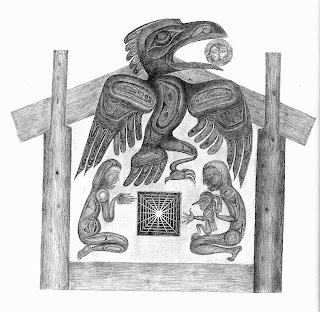
The Raven Steals the Light:  Bill Reid

This book tells the story of the people who lived off the Pacific coast of what is now British Columbia and Alaska, on the distant islands known as the Haida Gwaii - now inappropriately re-named ‘Queen Charlotte Islands’. The Haida Indians had a very specific culture and a unique language - a click language not related to other Nth American first nation languages, hinting at different origins. The Haida lived in wooden ‘clan’ houses around the bays and inlets of the islands. Each house had an elaborately carved pole outside that told the story of the clan.  It was both an address and a family history.


They were hunter gatherers, living off fish and berries, whales, birds, bears and anything they could catch. They valued art and story-telling (in poetry form) very highly. Every family had two sides - Raven side and Eagle side - and these two birds played a big part in their mythology, particularly the Raven - a trickster and shape shifter - who is at the heart of their creation myths.

With the arrival of western missionaries, in the late 19th century, the Haida culture was almost completely wiped out. In some villages more than 80% of the population died from imported diseases such as small pox, and their lifestyle was no longer viable. They went to work in factories and sawmills, and were given European names. More than a thousand years of art and literature was lost.

In 1901 an anthropologist went to stay there, learned their language and set out to record, word by word, some of their most important poetry from the elderly story-tellers who had survived. He transcribed hundreds and hundreds of pages - only about 1% of which was published at the time. And the original language texts of the poets and storytellers of the Haida Gwaii have lain unread ever since - perhaps because of their difficulty. Transcripts look like this (I’ve taken out all the glottal stops!):

Nang Kilstlas nagha ghahaw Tadl tsigha’awaaghan.
Sing qqalghada ll qaaxuhls
gyaan ll kindagaangas
sta lla xitkkudahldattsasi

This translates:
‘Loon was living in Voicehandler’s house.
She left the house at daybreak
and repeatedly she called.
Then she flew back in’

The poetry reflects the Haida beliefs that certain beings were able to shape shift between the three elements of water, earth and sky. Loon is a bird, but she’s living like a human being in a house - and in some stories Voicehandler’s house is at the bottom of the sea.

Scholar and poet Robert Bringhurst discovered the texts and has spent a large part of his life translating them into English, trying to keep their poetic form. This book offers some of them, with an account of the lives of the story-tellers and their lost culture. It’s a mixture of anthropology, poetry, history and biography. But at the heart of the book is a discussion about story-telling itself. ‘A story is not a solid object or a solitary entity but a transformative relationship.’

Very little in these tales is familiar to us - and not just what is in them, but also the way they are told. Why, Bringhurst asks, should we set the standards of what poetry is by using a system that originated in the east (originally Greek) - rhythm and rhyme. Why not a system just as ancient, but from a different part of the world - the patterning of ideas, thoughts, and events? The Haida had a system of 10 - objects, occurrences, themes, were grouped to add up to 10. Some of their stories are structured like two five-fingered hands.

Robert Bringhurst also offers some thoughts on the progression from oral story-telling to the written word. We think of reading as a modern thing -a product of civilisation, without ever thinking of the nature of reading itself; that words are simply another kind of human paw print to be read and interpreted by the tribe.

‘Reading, like speech, is an ancient, preliterate craft. We read the tracks and scat of animals, the depth and lustre of their coats ... We read the horns of sheep, the teeth of horses. We read the weights and measures of the wind, the flight of birds, the surface of the sea, snow, fossils, broken rocks ..... We also read, of course, the voices that we hear. We read the speech of jays, ravens, hawks, frogs, wolves, and , in infinite detail, the voices, faces, gestures, coughs and postures of other human beings. This is a serious kind of reading, and it antedates all but the earliest, most involuntary form of writing, which is the leaving of prints and traces, the making of tracks.’


I was interested to hear Haida spoken - there are only a handful of elderly Haida still alive who spoke the language as children. There's a video on YouTube 'The Surviving Sounds of Haida Gwaii'

The book filled me with sadness for the rapaciousness of our culture, which has wiped so many ancient cultures off the face of the earth, leaving only fragments. Language, which seems the least durable, has in the end proved more lasting than some of the solid objects the Haida made.

Bringhurst sums up:
‘language is a vehicle of knowledge and a key to the interlocking prisons of society and time. When it’s written down, it can let me hear from people who knew things I don’t know and saw things I can’t see because they lived in another time, in another world. Nothing language does seems more wonderful to me than that.’


Artwork by Bill Reid 1920-1998 from ‘The Raven Steals the Light’
© the Bill Reid Foundation
For more images visit http://theravenscall.ca/