Tampilkan postingan dengan label sculpture. Tampilkan semua postingan

Kamis, 08 Maret 2012

40 Women Sculptors for International Women's Day

As it's International Women's Day today, I thought it might be appropriate to post something about an exhibition celebrating the work of 40 women sculptors who have lived and worked in Pietrasanta during the last fifty years.

Whatever you think of gendered events, (and I know many of the women here are very ambivalent about them) it's difficult to turn down the opportunities that positive discrimination sometimes presents.   The work featured in this exhibition is extremely varied in style and subject matter and the sculptors come from almost every part of the world, including USA, Italy, Norway, Venezuela, Russia, Europe, and Japan.

They were all interesting, and I had my own personal preferences, but here are some that I found really interesting.  Sadly, one of my favourites, 'Dancing in the clouds' by American Shelley Robzen, can't be shown because it was highly polished black marble in a spotlighted situation which didn't photograph.  In fact, it was difficult to get any good photos at all, given that the church 'St Agostino' has no natural light.

My favourite artist of the older group,  Alicia Penalba (from Buenos Aires) died in 1982.  Her 'Trilogie'  - the three bronze figures standing at the entrance to the church, is really beautiful.


The gesso maquette for Grand Gisant reminded me of dinosaur vertebrae.


Again in the older group, the Italian Fiore de Henriquez who died in 2004, had a strange, almost feral bronze figure, full of quite violent life.  It's called 'Ippogrifo' - the Hippogriff.


I loved this small, alien landscape with its lonely figure by American Jill Watson who now lives near Pietrasanta.  It's called Giardino - garden.


This relief, by Swiss artist Maja Thommen, looks simple, but is incredibly intricate. She's a very interesting artist who paints, creates installations and also performs with a gypsy punk band.  It's called Donna Velata - veiled woman.


Dutch sculptor Margot Homan exhibited this bronze figure of a women holding her finger to her mouth - Il Silenzio.  It's very finely balanced.


There were some images that I found quite disturbing, including this male, almost zombie-like figure by young Italian artist Elena Bianchini.


Altogether a fascinating exhibition.  I'd have loved to do a creative writing workshop with it!

Minggu, 11 Desember 2011

Sculpture by Candlelight

It’s the festive season in Pietrasanta - Christmas markets, parties, and exhibitions.  We’ve been to several lately - nothing big, just quiet celebrations of current work in artists’ studios and small spaces.  


Last night one of the bigger marble studios opened up for the people working there to show their work.   Not just some lovely pieces, lit by candlelight, but a chance to see the context - the rough drafts of WIP.    This is work by Swiss sculptor Rita Meier.


There are so many wonderful women sculptors working here.   At one of the local wine producers, another artist, Swedish Nigerian Italian Yemisi Wilson was showing her ‘Animalia’ - lovely drawings of primates and joyful marble carvings of elephant seals and rhinoceros’s.   There was the added bonus of being able to sample the local wine harvest at the same time!


One of the real treats last night was being able to go up into the loft of the Cervietti studio where they keep the plaster maquettes of all the sculptures that the artigiani used to be asked to copy.  It’s a ghost gallery of figures out of fairy tales  - a film set for a horror movie.   These are just some of the ones that caught my eye.


I could have wandered around this attic all night - there are probably a thousand stories up here!  

Sabtu, 01 Oktober 2011

The Economic Crisis in Italy

Nothing illustrates the state of the Italian economy more clearly than the plight of the marble yards in Pietrasanta.  Once they were full of sculptors from all over the world and the skilled artisans helping them.  They worked alongside other artisans making commercial objects out of marble - fireplaces, statues for churches, floors, bathrooms - and it kept the town alive.  But over the past few years more and more marble yards have closed and there are fewer and fewer places for sculptors to work.  Recently the pace of change has accelerated.  Last September the yard Neil worked in had to close when the owner decided to sell the land for a block of flats.  He and a few other sculptors found a new studio in a beautiful location with good working conditions - it all seemed set to continue happily.  But the owner has been hit by the economic downturn during the summer - no one can afford fireplaces, or marble floors, garden statuary, and even the church is cutting back on renovations.  Yesterday, Friday, the sculptors were suddenly told that the space had been sold and they had until Sunday to remove their work.  Temporary space will be made for them on another part of the site, but it's been a big shock.
Packing Up
Ready to go


The newspapers are full of gossip stories about the private life of Silvio Berlusconi and rumours about his business dealings, but he remains the most powerful man in Italy, despite the fact that the country has one of the biggest national debts in Europe.   We are watching our Italian friends struggling to make a living and hope that Italy will survive.  The cartoon below is doing the rounds of the bars at the moment and really sums up the ordinary Italian's attitude to SB.    It's called 'the Trouser Salute'.


Jumat, 16 September 2011

The Flowing Forms of Helaine Blumenfeld

Taking Risks

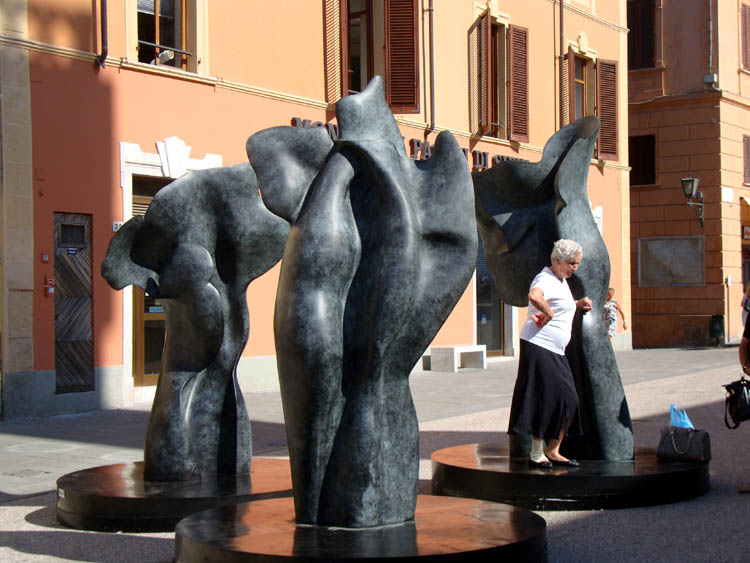
This is the latest exhibition in the Piazza at Pietrasanta and one of the nicest for a long while.  The work, in marble and bronze, is by a woman called Helaine Blumenfeld.  Do check out her site because her photos are much better than mine! Helaine is one of the older generation of sculptors working in Pietrasanta and very distinguished.  She originally studied in Paris under the Russian sculptor Zakhine and has built herself an international reputation. 
Helaine's personal studio

She’s based here, working in her own studio and in the marble studio SEM and specialises in exploring the territory between figurative and abstract forms.


These three bronzes I think of as three dancing women and I was amused to see some older Italian women out shopping and taking turns to pose for photographs beside them!


Pietrasanta is gradually getting back to its normal self after the tourist chaos of the summer.  One innovation is that the local police have adopted very strange two-wheeled vehicles to patrol on.  The Carabinieri of course, still dash around in cars!


Sabtu, 10 September 2011

Neil's New Marble

Today is the day Neil's latest opus in marble has come home from the yard to be erected in the olive grove.  It's always a question of where to put them if you don't sell them straight away.  And if you're collecting things together for an exhibition, storage is a problem. Luckily there's a lot of olive grove out there just waiting for a few sculptures to liven it up!


The Process starts with the hunt for a suitable piece of marble.  You have to go to a quarry, or to a quarry yard, and look.  Some of the blocks weigh tons and cost thousands - sometimes tens of thousands if you want particular colours or quality.


Neil is looking for a smaller piece that costs a lot less!   In the marble yard where he works, you can get offcuts - they make shelves and fireplaces and marble porticos.  There's a huge machine for cutting the marble and they have compressors for power tools.


The sculptors work in small cubicles behind the main commercial workshop.   This is Neil's marble in a more advanced state.


This new sculpture weighs a lot, even though it's small, so a forklift and a lot of manpower was required to get it into the back of the car and then out again, protected by wood and polystyrene.  It came down the path on a bogey and Neil has used some acro-props to erect a primitive lifting device using a 'paranca manuale'  to winch it up.    It was all very tricky.


Still some work to be done inserting metal pins into the marble to hold it.   But the finished product looks fantastic.  Just waiting now for someone to ask 'what is it meant to be'?


Kamis, 11 Februari 2010

On Not Writing in Italy

I’m living in one of the most beautiful places on earth, steeped in history and artistic tradition, so why can’t I write here?
The idea this winter was that while Neil was chipping away at his marble block, I would be tucked up cosily in our borrowed house, free from all the domestic trivia of ‘home’, gazing out of the window at the olive groves and writing like a train. I’ve got several projects in various stages of development and a big story that I’m trying to piece together. Uninterrupted time was, I thought, going to give me a fruitful couple of months or three to work on them.
But it hasn’t happened, and I don’t know why. One of the reasons is space - the only warm room in the house is the kitchen/diner, which has a small stove, but for some reason, although I use the computer there, I can’t write in this room. I seem to need a comfortable, cosy corner to curl up in. I also need privacy - a space where I can shut myself away without fear of interruption.
There’s also the exhaustion factor - I think I’m utterly worn out after the editing of the Mansfield book. But whatever it is, it bothers me, as I see the weeks slipping away and I’ve got nothing to show for the time spent here.
Maybe I’ve simply got to face the fact that I’m the kind of writer who needs her own quiet den to work in, surrounded by her own books and familiar things, without the disruption of travel and new places and faces. It’s stimulating, but not conducive to that quiet, dreamlike state where creative work is incubated and eventually hatched. It’s all input and no output at the moment.
There’s no end in sight yet. I’m off to London tomorrow for a couple of weeks of frenzy. Meetings with agents, and a trawl through the British Library and National Portrait Gallery for illustrations for the biography. Meanwhile, Neil’s sculpture now looks like this.

Rabu, 13 Januari 2010

Back to Work


Xmas is over now and all the offspring have returned to their own homes, despite snow, ice, delayed and cancelled flights and other obstacles. So there’s no excuse for not getting down to work again. Neil has returned to the marble yard where he’s converting a plaster maquette into a glittering white marble sculpture. He has bought a block of ‘statuary grade’ Carrara marble, which looks rather like Kendal Mint Cake. You can see it above. The man standing is Pietro who is providing the marble and the blue overalls belong to Anat, an Israeli sculptor who owns the marble yard.

Marble yards are filthy places - white dust everywhere like snow; pieces of marble piled up haphazardly among the machinery; fork lifts and hoists. Even a small piece of marble weighs a ton - quite literally.


Since Monday Neil has been attacking the block with an angle-grinder and diamond blade. I would be terrified of sawing off the wrong bit - unlike writing, once something’s edited out, it’s out for good! But his block now looks something like this.


And I’m back to the editing of the book - now working on the end notes and references, which is a long and frustrating process. Will my reputation as a biographer really be ruined if I can’t read my handwriting when I jotted down a reference 5 years ago? I don’t believe it will, but my editor has other ideas! Thank goodness for the internet.

The weather here is still cold and often wet. We are staying in a large, unheated house with marble floors, high ceilings and draughty doors. Last night it was cold enough for two duvets, a pair of fleecy pyjamas, a cardigan and the electric blanket. But at lunch-time I went outside and ate my lunch on the terrace in the sun. Miraculous!

Minggu, 22 November 2009

The Year of the Floods - Again

It seems unfair to be sitting in warm Italian sunshine, while my home county is under-water and the lead feature on the international news. It’s been an anxious time - we live in an old mill on the banks of a big river and it floods regularly. Before we left we stripped everything out of the ground floor, just in case the water rose high enough to come inside. And on Thursday it happened. A series of telephone calls as the river rose. Appleby on the news as residents filled sandbags and evacuated their belongings, expecting the Noah-style inundation we had in 2005 which almost reached the ceilings and made thousands of people homeless across Cumbria.

You can see from the picture the force of the water powering its way through windows and doors - the lintels of two windows are just visible. The wreckage left behind can be seen from outside in the photo taken next morning.
This time, it only flooded the ground floor of the mill (which is raised up about four feet above the river) to a depth of six inches, leaving a mess of mud and river debris. Appleby's riverside shops and houses were also flooded, though it escaped the worst of the weather. Other towns and villages weren’t so lucky and some of our friends are homeless again only five years since they were last flooded out. Neil has gone home, while I watch the internet news with disbelief at the scale of the flooding.
Living as we do with the rising and falling of the water, we’ve got used to compromising with it. I don’t grow anything in the garden that doesn’t survive being under-water. We don’t use the ground floor except in summer. We park our cars at the top of the hill as soon as it begins to rain. And, although it washes away my garden soil and floats off anything not tied down, it also brings gifts.
Last winter it left two beautiful
'accidental' sculptures on the weir. One a branch like a water sprite, trailing her arms in the water; the other a tree-stump like the head of a beast. They stayed there for a couple of months before the river rose again, carrying off the naeid, and moving the ‘beast’ up onto the river bank next to my garden.


There he’s remained all summer like a primitive carving - a god of the river - looking at me every time I glance out of the window. I suspect, after the water levels of the past few days the river will have moved him on, perhaps to dump him in someone else’s garden and I will be very, very sorry.

Kamis, 03 September 2009

Vazha, Sculpture and the Misty Mountains of Pruno

+
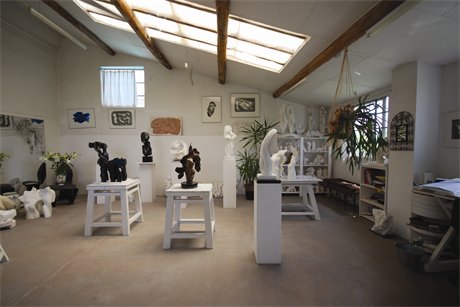
I've just come back from the studio of Vazha Mikaberidze, who sculpts as 'Prasto'. Vazha is a Georgian, living and working in Italy. His work extends from the figurative to the abstract and even the conceptual and his studio is crowded with examples. Huge textured plaster sheets stand against the wall, with seductive tactile patterns. Vazha takes a rubber mould from the trunk of particularly interesting trees. He then cuts it lengthwise and opens it out flat to reveal the patterns of the bark, selecting sections to cast in plaster and then in bronze or nickel. In another corner a life-size man springs from the wall, arms spread out, his jacket flying on either side like wings. This is Sergei Parajanov - a Georgian film director whose work and personal
beliefs put him in a soviet gulag for more than six years. The plaster model, bursting with character, is the maquette for a bronze outside the opera house in Tblisi.


Around the floor are beautiful abstract forms - many of them referencing the natural world. Delicate figures form a circle around a pair of feet, like a corps de ballet - a sculpture that was actually made as a stage set for a ballet. It is part of a body of work that is a homage to the choreographer Balanchine which Vazha is currently working on though the project is on hold at the moment until the situation between Russia and Georgia is resolved.


Vazha's stories are a reminder that, whatever the problems of funding in Europe, the politics of art are much simpler and less dangerous here than elsewhere.


Afterwards we drove up into the Apuane to have lunch at a little hill village called Pruno, where you can have a plate of home-made pasta with wild-boar sauce for 6 euros and where the wine comes in earthenware jugs.


The weather is changing with the full moon. After two months of searing temperatures and no rain, clouds are gathering over the hills, and everyone is hoping for some wet weather. The trees are scorched to brown and the rivers are dry. Tonight it is so humid our clothes are sticking to our backs and the mosquitos are attacking every square inch of skin not coated with chemicals. Not quite paradise - but almost!

Selasa, 01 September 2009

Pietrasanta and the Anti-art Movement


The small town of Pietrasanta (the name means sainted or blessed stone) has been at the heart of the marble industry in Italy for more than two thousand years. The five thousand foot mountains that surround the town have been chiselled away by centuries of intrepid quarrymen and from a distance you can see glaciers of glittering marble waste slithering down gullies towards the valley floor. On the precipitous roads, marble lorries thunder past like mobile earthquakes, leaving a drifting fog of white dust behind them.

You can still climb up to the quarry where Michael Angelo found the block from which he carved David. You can still see the old building where he may or may not have stayed while he was here. Pietrasanta lives off the sculpture industry and there are also several foundries where sculptors from all over the world come to get their work cast into bronze.


Henry Moore had much of his work cast here, as did Noguchi, and now Barry Flanagan, Kan, Bottero and Mitoraj all have work standing in the yards. The infamous statue of Saddam Hussein started out here too.

Residents of Pietrasanta are descended from generation after generation of artigiani, skilled at realising the work of others and turning plaster or terracotta maquettes into life-size works of art. The Anti-Art Movement, which began with Dada, wants to leave the traditions of the past behind and deconstruct all our notions of art. It too, is alive and well in Pietrasanta.


I’ve just been to the opening of an exhibition of Antonio Luchinelli’s work. He is one of those who can trace their ancestry back through the artigiani and he is best known for making moulds for the world-famous Kan. Antonio is a skilled mould-maker - meticulously reproducing whatever he’s given. This exhibition of his own work - a statement of his personal espousal of ‘Anti Art’ - is a series of pieces linked by a play on words, though I have to confess that I couldn’t engage with it at all, even when the linguistics were explained to me.

But then I’m on the side of art - with or without the capital letter - and I don’t believe it needs to be elitist - anyone can do it on any level, like writing. But I also believe that some people can do it better than others. I know I’m making a qualitative judgement when I say that; I know that everyone is entitled to read or look at whatever gives them pleasure, but - in my opinion - there is a lot of crap out there fetching huge sums of money. And there are an awful lot of people, in art and anti-art, who share the Emperor’s tailor.

Minggu, 05 Juli 2009

The short story vs the novel


Back from Italy and loving the Italian weather in England. Neil’s sculptures look wonderful among the olive trees - it was very hard to leave. But now I must get down to the business of choosing illustrations for the biography and sending off endless letters and emails asking permission to use quotes and photographs. I’ve found a wonderful photo of KM in an out-of-print book which Penguin want to use for the cover, but I can’t find out who has the original.


I’m also working hard on a talk about Dorothy Wordsworth for the Gaskell Society conference, being held in Cumbria this year, and trying to finish a short story. Why are they so difficult? Why should 3,000 words give me more trouble than 30,000 words of anything else?

The problem is that you’ve got to have all the depth of back-story and characterisation that there is in a novel, without the space. The words have to work hard. KM thought the difference between a novel and a short story was the amount of time it was exposed to the creative process. ‘In the case of the short story it is possible to give orders that, unless the house is on fire – and even then, not until the front staircase is well alight – one must not be disturbed; but a novel is an affair of weeks, of months; time after time the author is forced to leave what he has written today exposed to what may happen before tomorrow. How can one measure the influence of the interruptions and distractions that come between?’

For me, the difference is also structural. A short story is like walking past a house in a dark street - I love doing that when all the lights are on and none of the curtains drawn. You can look in and see the people in the rooms, talking, doing small domestic things - glimpse odd emotional dramas, but then you walk on. All you have in a short story is that brief snapshot. In a novel, the front door would be open and you’d be able to go inside the house, wander around, price up the furniture, peer into the cupboards, have a glass of wine in the back garden, and get to know the people intimately. You’d have all the time and space in the world before the fire brigade arrived!